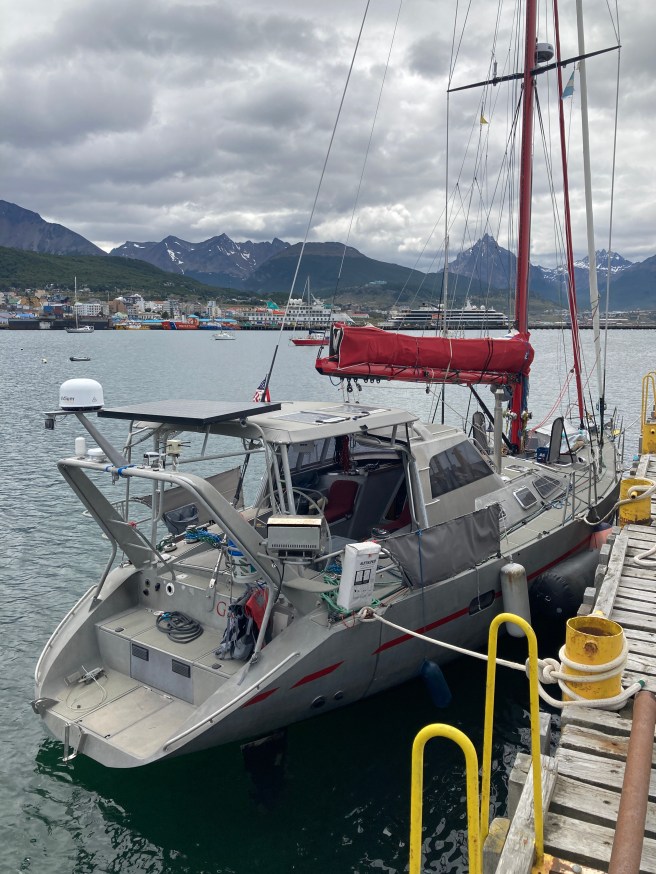
Following are updates I sent to family and friends during my recent cruise aboard a Garcia Passoa 50’ aluminum sloop named Gringo with owner Barry Kennedy. Our crew included Martha, Todd, and Todd’s son Dalton, all of whom hail from Colorado. This was Todd and Dalton’s first time ever aboard a sailboat. Martha’s prior sailing experience has been a recent passage aboard Gringo from the Galapagos to the Gambier Islands. – Max Fletcher
Part One: Ushuaia, Argentina
I arrived in Ushuaia Dec 3 after 27 hours of travel from Boston, which includes changing airports in Buenos Aires. Ushuaia feels like the frontier town that it is, the ‘end of the earth’ as the town touts itself, and the gateway for expeditions to Antarctica. It is ringed by black snowcapped mountains and the wind frequently blows hard. No wonder, Cape Horn lies just 55 miles south.
Economically, too, Argentina feels like the Wild West. The country’s inflation rate is trending towards 100% this year. I was advised to bring clean, unmarked US $100 bills and avoid using ATMs and VISA cards. The official exchange rate is currently about 160 pesos to the dollar, and that is what you will get using ATMs and credit and debit cards. But you can take your crisp US bills to certain places around town called Cuevas and get the “Blue Dollar” exchange rate of about 300 pesos per dollar – making everything nearly half price. The system falls in a legal grey area but seems to operate pretty much in the open.
As an example, I booked a hotel for my first few nights using Hotels.com at a price of US $120 a night. But rather than charging my VISA US $120, the hotel let me pay in pesos, calculated at the official rate of 160. By using pesos exchanged at 300, the room only cost me about US $65 a night. Taxis, food, restaurants and most everything else are very reasonable. An excellent rib-eye steak in one of the fancier restaurants might cost $12, a cab ride $3, and a decent bottle of wine $4.
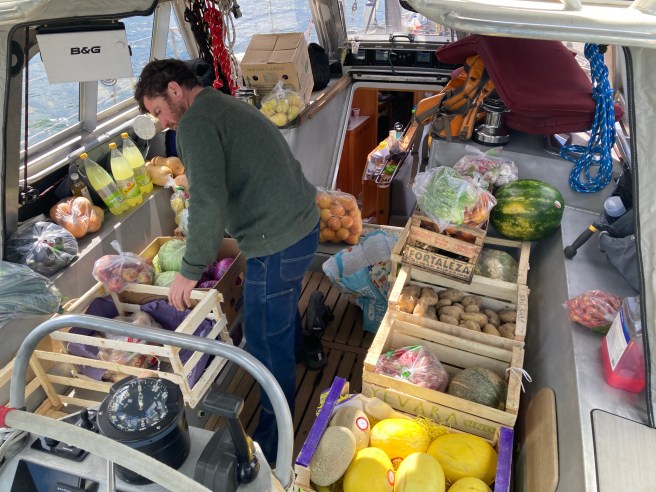
The boat has been tied up at one of the two nautical clubs in town. Barry has been doing last minute generator repairs, fueling, provisioning, and all the other myriad details involved in getting ready for a passage. Everything takes on a heightened significance since we need to be entirely self-sufficient for 3+ weeks in a hostile environment.
The weather currently looks good to leave late afternoon Sunday. Clearing customs out of Argentina will require 3 stops and take about 3 hours. Once en route, we will radio the Chilean navy and ask permission to sail down through their islands which would give us a little more protection. If they deny permission we will have to stay more to the east (Chile and Argentina do not get along, so border issues are sensitive).
Once clear of Cape Horn we will try to head somewhat west of south in order to gain some distance to windward against the prevailing westerly winds and seas. Barry is using a professional weather router, Ken McKinley from Camden, Maine, to help with weather advice (Ken oversaw our transatlantic sail on Juanona the summer of 2021, and Barry was very happy with Ken on his recent sail from Newport to Ushuaia via the Panama Canal).
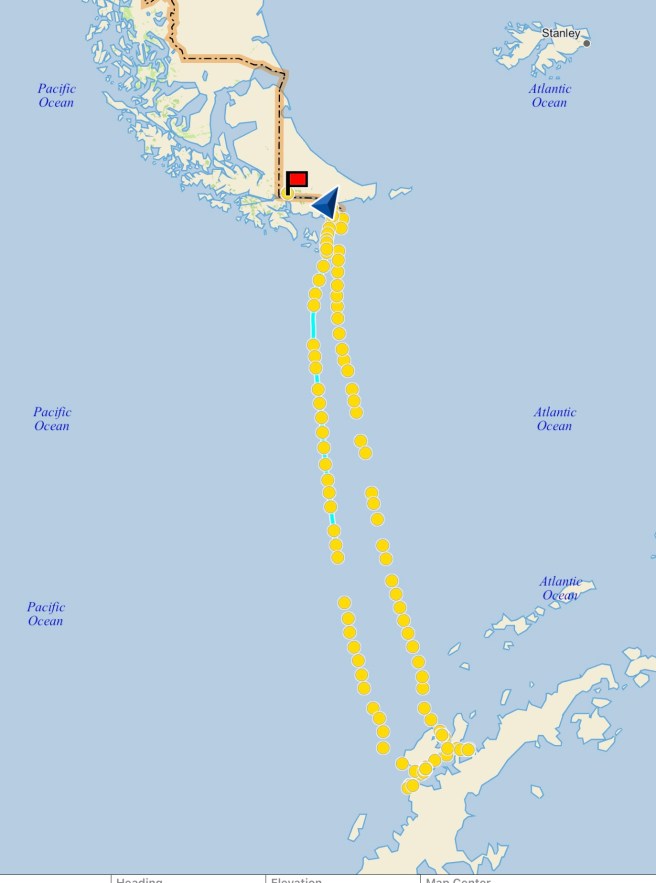
Halfway across Drake Passage we will assess the weather forecast. If the outlook appears settled we will stop at Deception, a large volcanic island and former whaling station. If the winds don’t look settled we will keep further to the west and head for the Melchior Islands. Barry doesn’t want to stop at Deception and then have a tough slog sailing the ~100 miles to the Gerlache Strait if the winds turn out to be contrary.
We will look for a window to return to Ushuaia shortly after Christmas, likely leaving from somewhere west of Anvers Island.
Sun AM update: we plan to leave this afternoon. The weather forecast looks pretty benign for the next few days, the “Drake Lake” not the “Drake Shake” as the veterans down here call it.
Part Two: Ushuaia to the Antarctic Peninsula
We had an appointment to clear customs at noon Sunday. The officer was in a jovial mood, made good light of our captain’s given name being John F. Kennedy, and pretended mock laughter when he looked at each of our passport photos. Always nice when you get friendly port officers.
We were getting ready to depart when the wind kicked up from the east, exactly the direction we wanted to go, and created quite a chop in the harbor since it is open to the east. We decided to wait an hour. Thankfully we were on the leeward side of the docks but 3 sailboats rafted together on the windward side started pitching wildly and crashing into each other. It was an untenable situation for them and we helped them depart, one by one. Each boat would run an aft spring line from the bow, kick the stern out, then motor hard backwards into the seas. All 3 made it out apparently without damage.
We could have motored overnight into the wind and chop with our 3 new crew members who had just flown in from the US – or we could go to an Italian restaurant for dinner and get a good night’s sleep. We chose the latter and departed at 4:30 the next morning, motoring out the Beagle Channel in a flat calm.
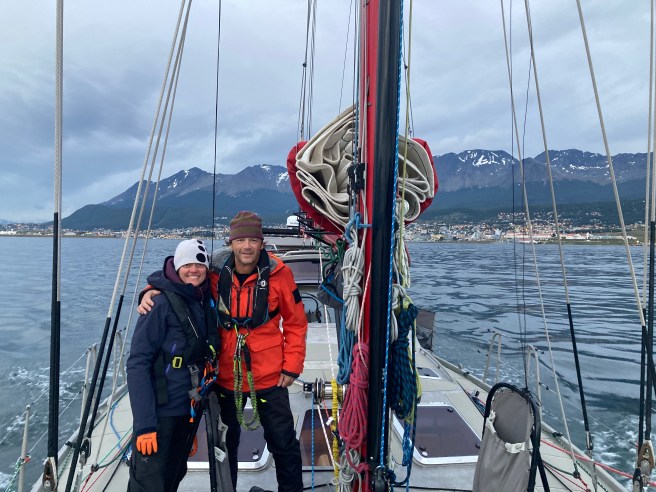
The Chilean navy denied us permission to sail down through their islands, so we motored out to the end of the Channel and turned south. The engine exhaust started appearing darker than it should and the engine was on the verge of overheating. We traced the problem to bits of kelp not only in the seawater strainer, but partially blocking the seawater pipe itself.
Monday night at around 3 AM we passed well to the east of Cape Horn – the same time of day Rob Andrews and I sailed by in 1985 on a passage from New Zealand.
Tuesday afternoon the wind filled in and we spent about 10 hours in 35-45 knot winds, gusting into the 50s. We were on a broad reach (the wind aft of the beam) and the boat handled it well. The seas had been pretty flat to start with, and while they built to the 10-14 ft range they were very manageable.
Wednesday was calmer and sunny, and seabirds filled the sky all day long. The numerous Albatross flying around seem to be very curious, gliding past the boat to check us out. We crossed the 60th parallel which is the approx. location of the Antarctic Convergence – the boundary between the northern temperate zone and the polar air and water masses. Air and water temperatures both dropped from about 6C to 1C (in retrospect I remember seeing an area of fog which may well have indicated the boundary). Fortunately we have a Wabasto heater which keeps the main cabin warm (and a Refleks heater once we get into port).
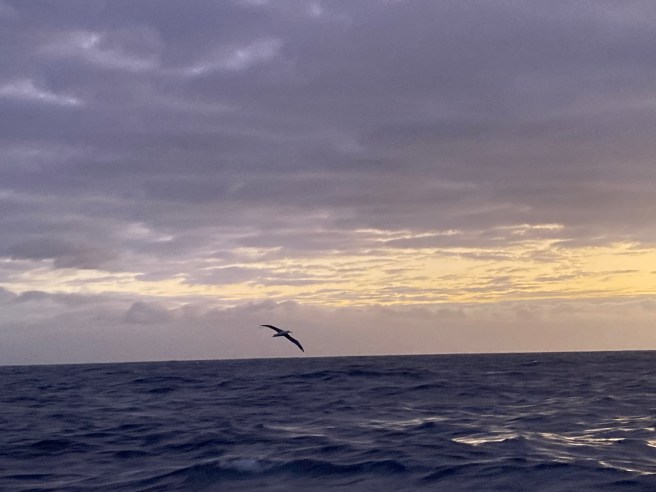
Barry, Martha and I take turns on watch, 3 hours on, 6 off, but I am often called during my off watch to help put a reef in the mainsail, or sail the boat while Barry works on the engine or for any other need. I sleep whenever I can to have a reserve for times of need. Barry of course is up a lot as only he understands all the systems which have required attention (water maker and fuel filters to name a couple). The mainsail is quite high above the deck, making reefing a bit challenging, but the boat is well laid out and otherwise relatively straightforward to handle.
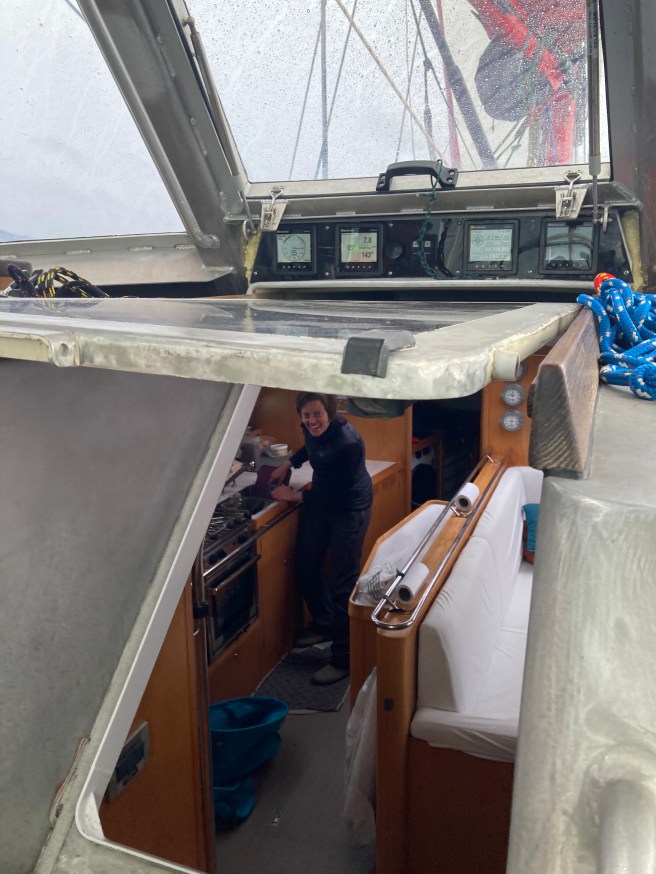
Martha has been making some excellent meals. I took a photo of her wedged in the galley with the anemometer recording a 55-knot gust. Pretty remarkable considering her first-ever sailing experience was recently joining Barry to sail from the Galapagos to the Gambier Islands in French Polynesia. Meals have included creamed cauliflower soup, sausage and gnocchi with green chilies, a Southwestern dish called posole hominy, and chicken risotto with mushrooms and butternut squash.
Todd and his son Dalton, having their first sailing experience ever (!) have been acclimatizing to life at sea and gradually learning the ropes. Todd is a world class mountaineer and it has been interesting to learn of his adventures on some of the highest peaks in the world.
Thursday the wind piped up and we were able to resume sailing. Someone pointed out that the enormous white mass that looks like a billowing cloud off to port was actually an island! Smith Island is being uplifted by plate tectonics and presents high, steep snowbound peaks formed of particularly dense rocks formed deep underground and therefore less prone to erosion. I had noticed it earlier in the day and mistook it for a bright cloud.

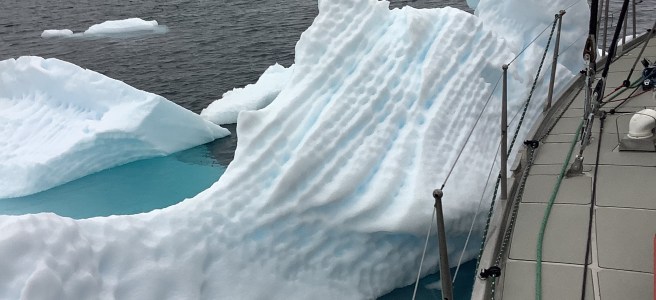
Friday morning we entered the Melchior Islands archipelago, first passing rocky islets covered with snow, then turning a corner into a true winter wonderland – a winding passage between high snowy peaks dazzling white and blue all around us, fog swirling around their tops – an otherworldly, surreal landscape that defies description. Hopefully photos and videos will do it justice.
We spent an hour getting the dinghy inflated and launched, then Barry and Todd took it to a protected cove to scout locations to tie shore lines. After another two hours we had an anchor down and four long lines tied to shore holding the boat in place. We felt secure enough to imbibe a shot of whiskey and relax after the journey (and for me, finish this update).
We will spend a week or ten days cruising the Peninsula, Happy holidays to friends and family back home.
Link to a video of the Melchoir Anchorage (click the “video” hot link)

Part Three: The Antarctic Peninsula
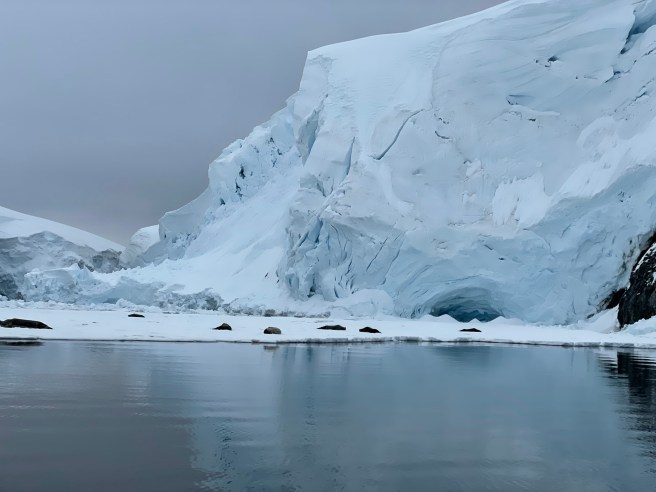
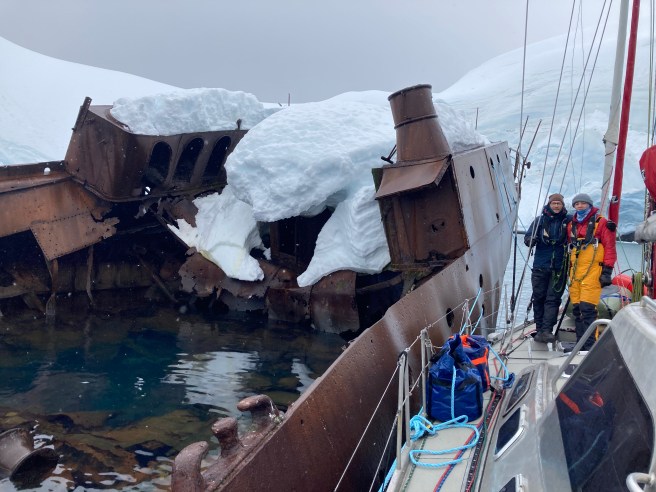
Our first stop after the Melchior Islands was Enterprise Island, where we tied up alongside the rusting hulk of a grounded whale-oil processing ship from 1915. The ship caught fire so her skipper steered the ship into the harbor and ran it aground in order to save his crew. Martha and I paddled inflatable kayaks around admiring the icy scenery while Todd and his son scaled a small mountain and skied down. During the night a daintily carved iceberg about the size of our boat drifted into the harbor and rafted alongside us for much of the night.
Barry’s permit to cruise Antarctica specifies nothing is to be tossed overboard – including food scraps, paper towels or TP – in order to help prevent contamination of the environment. We have 3 large dry bags in the transom for all our trash and recyclables. We also have antibacterial tablets that we mix with seawater to wash our boots for trips ashore, to help prevent the introduction of non-native bacteria.
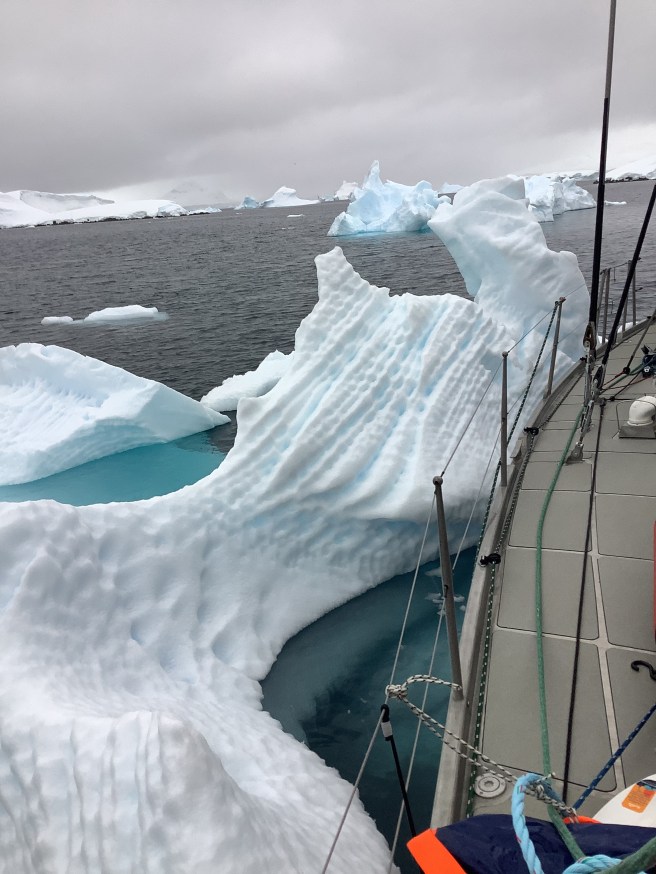
During our next daysail, down to Port Lockroy, we passed a small iceberg dotted with penguins seemingly in a frolicking mood, jumping around and making a great fuss. Or perhaps they were worried that their home was now adrift in the Gerlache Strait and a considerable distance from solid land and safety from predators. The final stretch through a long channel into the harbor was blocked by an area of brash ice and large bergy bits. After poking around a bit Barry chose a spot and plowed the boat right through, a distance of 250 ft or more, some of the larger chunks of ice slowing us down only slightly. Nothing like an aluminum hull and a powerful engine.
Approach to Port Lockroy video
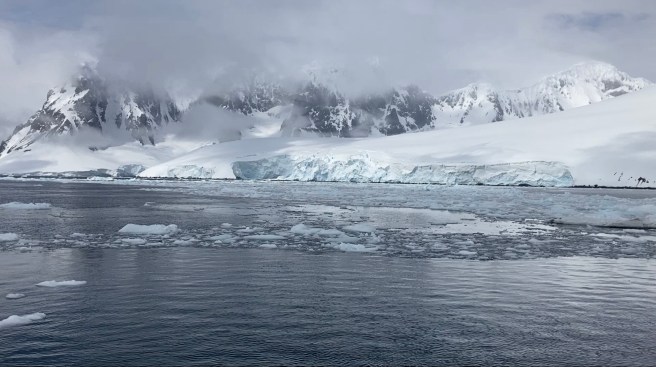
Plowing through a field of ice video

Once again Barry and Todd took the dinghy in to scout attachment points in a tiny anchorage protected by a couple small islets. Barry likes to have the ‘shore party’ -Todd in our case – pre-tie one of our four 100-meter lines to shore so that the moment the boat comes in and anchors, one shore line is ready to go and can be attached to the boat immediately after anchoring. This is typically done on the windward side in order to hold the boat in position while the other three shore lines are deployed.
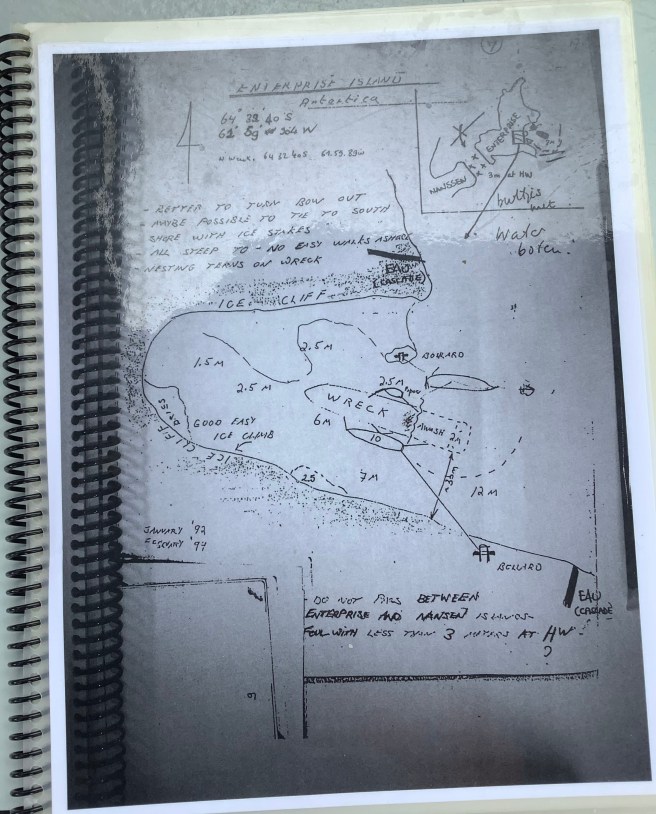
Details on most of the anchorages suitable for yachts have been passed down amongst the handful of yachtsmen and -women who have ventured down here in recent decades. They are rough hand-drawn sketches and include details such as landmarks, suggested places to drop an anchor and tie to shore, the locations of uncharted rocks and any other info that might be of use. Such info is critical to sailing here – safe anchorages are few and far between and there is little room for error to keep the boat secure and avoid dangerous situations.
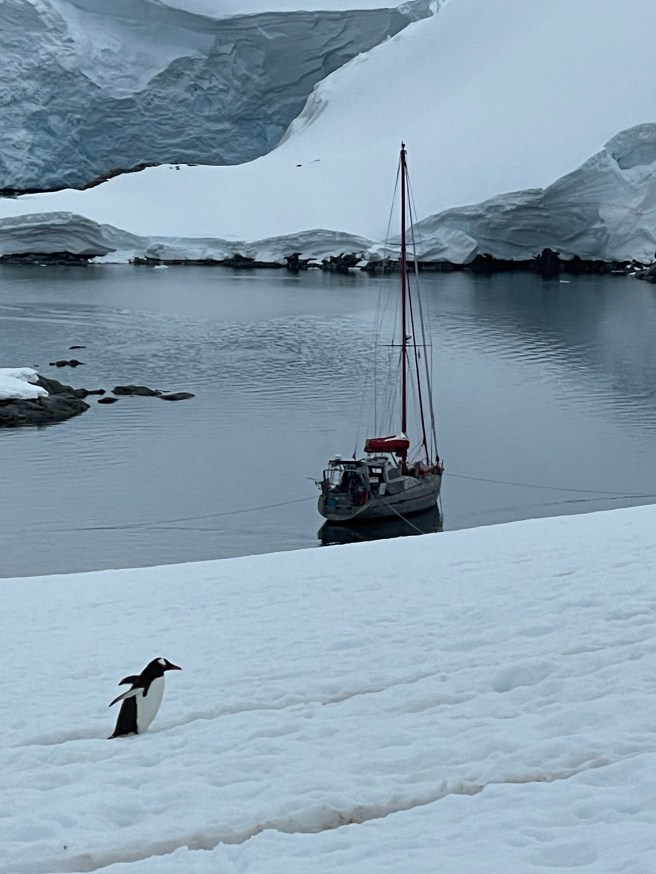
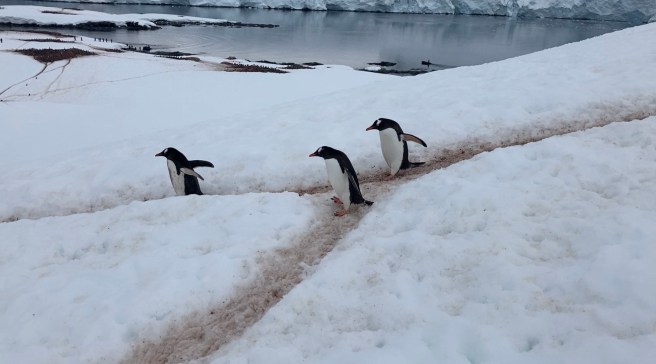
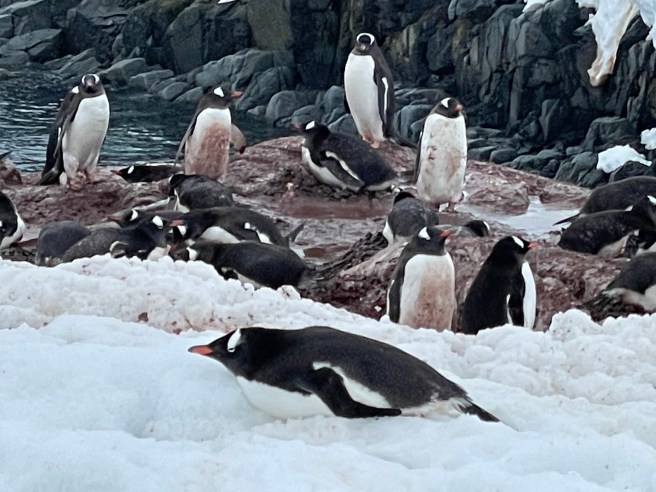
Our cove at Port Lockroy was surrounded on three sides by snow-covered hills containing numerous penguin rookeries. We loved wandering around and watching them strut up and down the hillsides, while keeping a respectable distance away from the birds and their footpaths. December is breeding time for the Gentoo penguins and we saw quite a few sitting on their eggs. Their mates were busy bringing them small stones to use for their nests. I used the occasion of being on dry land to stand on my head to honor my late dad, Abbot, who stood on his head at the South Pole in the mid 1990s when he was 73 years old.
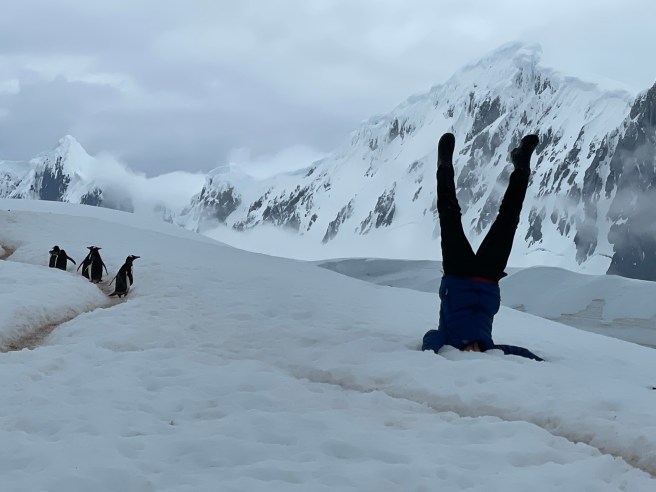
Amongst the penguins video
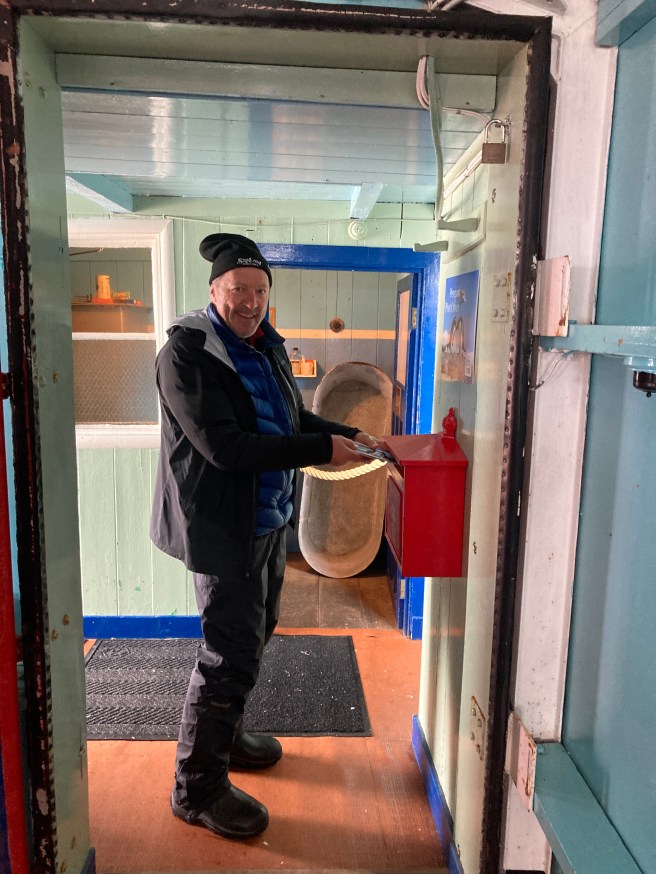
The next day we took the dinghy around to the Port Lockroy base, the site of the first permanent British base in Antarctica. The original structure is preserved as it was when abandoned a half century or so ago. The young women manning it were most friendly and informative, and we were able to purchase a few mementos and mail postcards from the only Post Office in Antarctica.
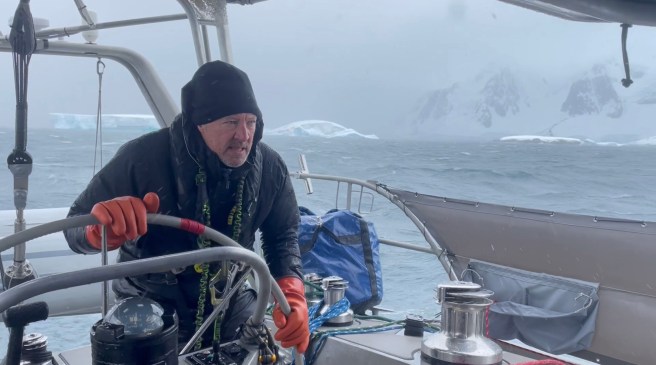
We started off on the 20 or so miles to our next anchorage when the wind unexpectedly built to the 35-40 knot range. We had to wind through some relatively narrow channels that were partially blocked by both grounded and floating icebergs. We were sailing downwind at about 5 knots with just a handkerchief of jib rolled out. It was sometimes hard to judge – and we had little time to assess – which side to leave each iceberg in order to stay in the channel, so Barry watched the chart while I steered for the last couple hours of the trip. With the wind still howling we eventually came to a bay named Port Charcot where we tucked up in the lee of the land and set an anchor to wait out the blow. It took 3 tries but eventually our anchor held in about 20 meters of water with 60 meters of chain out.
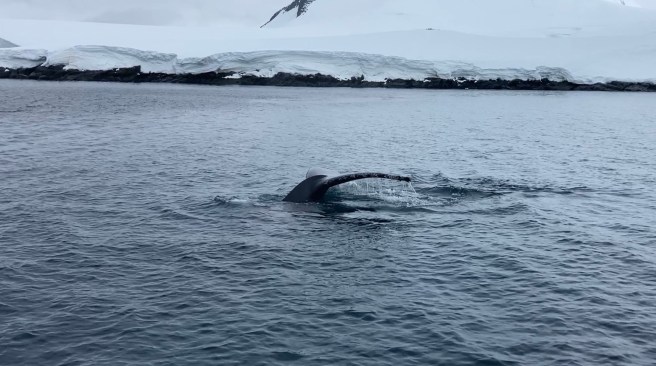
Whale at close range video
A blustery sail through icebergs video
The penguins on the hills above the anchorage had to walk an exceedingly long distance to get from their rookery down to the tip of a long point where they could jump in the water. It seemed like an inefficient use of their time and energy to have to walk so far but perhaps there is a survival benefit.
The next morning we motored over to Hovgaard Island where we hoped to tie into a tiny cove. By the time we got there the breeze had again kicked up and made it hard to keep the boat positioned in the narrow channel so we headed back to Lockroy to anchor, via the dramatic Lemair Channel. Nothing is easy in these waters.
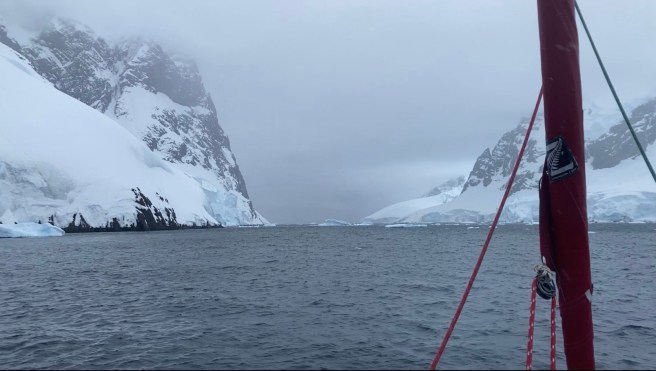
The Lemaire Channel video
I have been staying reasonably warm when on deck with temps in the low 30s, often with rain, sleet or snow and plenty of wind. Footwear includes a pair of merino wool socks covered by waterproof SealSkinz socks inside oversized Arctic Sport muck boots. For legs I have a thin pair of merino pants, insulated hiking pants, and ski pants. Torso is a merino T-shirt, 2 pair merino long sleeve undershirts, a heavy merino shirt, a down fluff jacket, and a waterproof windbreaker shell. I typically wear 2 neck gaiters – one for the neck, the other to pull up over mouth, ears etc. And a woolen hat along with the jacket hood if needed (my shipmates all have at least one garment such as merino shirt or down jacket that has a built-in hood, which would have been a good idea if I were to do it over). My fancy Sealskinz gloves aren’t as warm as I had hoped and I usually wear a pair of $14 Arctic insulated rubber gloves a lobsterman who works at Hamilton Marine recommended to me.
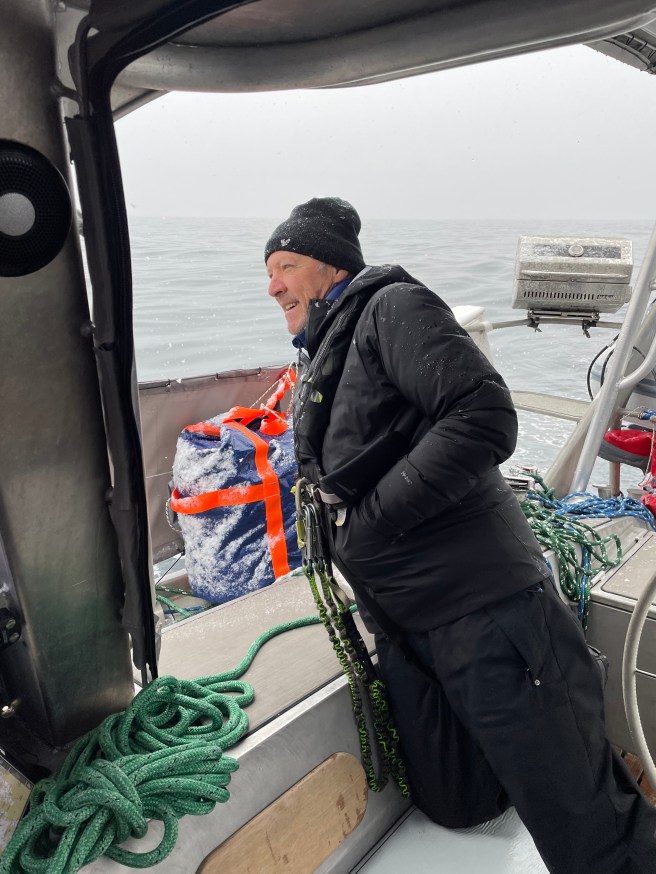
Highly experienced UK sailing friends had recommended a one-piece “Weezle” suit made for divers to wear under a dry suit. I hoped to bring it but with all the boat parts I was bringing down I ran out of space in my duffel. If I had to do it over I might have brought the Weezle and left behind my Mustang 1-piece Floater suit that I have used only once (though might be the clothing of choice if we have some seriously wet weather on the passage home).
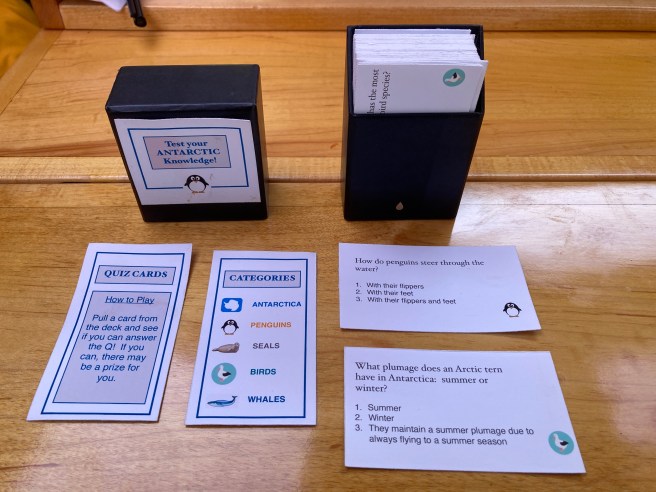
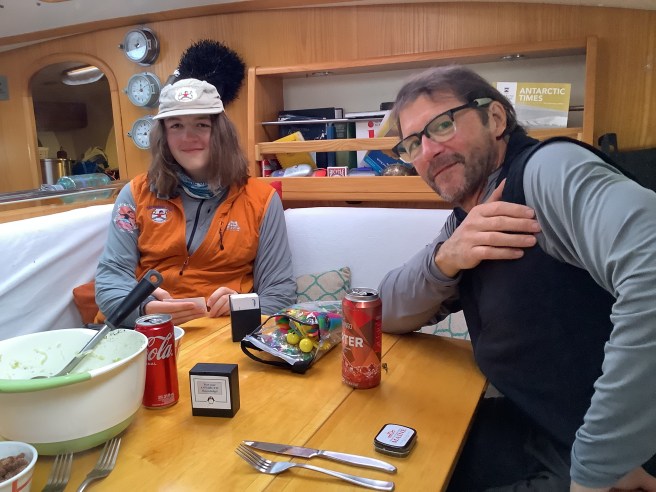
For entertainment we sometimes play cards or liar’s dice. Unbeknownst to me, prior to the trip Lynnie had gone through my Antarctic cruising books and created a Trivia game with multiple-choice cards – fun facts based on 5 categories: penguins, whales, seals, birds and Antarctica. For example: “How does a penguin steer?“ (A: with its feet) or “Which flying bird can dive the deepest?” (A: The Antarctic Shag – 371 feet!) We have all enjoyed the game (and appreciated the creativity that went into it!)
Unfortunately we haven’t had many days with crystal-clear see-forever skies. But what we have seen of the land has been magnificent. The penguins alone are worth the effort of getting here, and we’ve regularly seen whales and seals. We are watching the weather patterns to find an appropriate window to sail back to Chile. It appears Saturday afternoon may be a good time to leave in order to beat some nasty weather late next week.
Part Four: The return voyage to Ushuaia
While anchored back at Port Lockroy, we were hailed on VHF radio by Lockroy Base to ask if the Gringo crew would like to come visit “for tea or stronger.” We dinghied in to a warm welcome by four delightful young women who “womanned” (vs manned) the base. They had arrived in November to a cold hut that needed to be powered back to life, and they will be there until March, doing penguin and climate research and welcoming cruise ship tourists. We were their first social guests of the season. The four young women couldn’t have been lovelier – no surprise considering they were chosen from a field of 4,000 applicants and had been put together as a team after psychological tests. One had an environmental studies Masters, one was a PHD candidate in conservation biology, one was a retail specialist (who ran the small Lockroy store), and one did leadership training at Cambridge University.
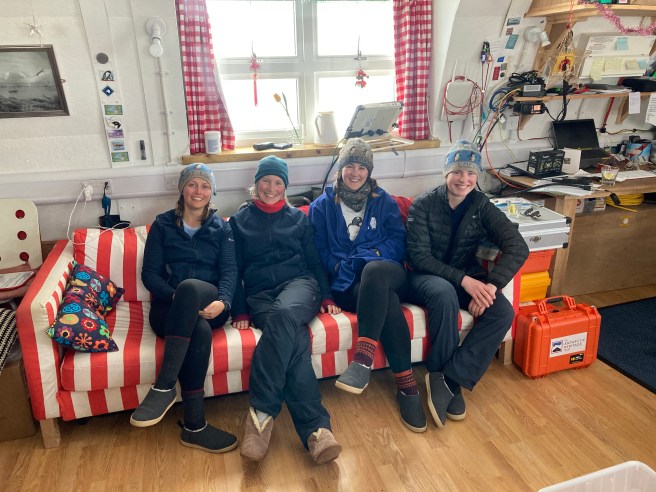
The Lockroy Base has performed 75 years of unbroken survey and research. Joined now by numerous other Antarctic bases, they are performing increasingly important work as the global climate changes and Antarctica plays a significant role in the consequences.
All that day we had heard reports like cannon or gunshot and then seen sections of ice and snow falling off the cliffs surrounding the harbor. The next day, Saturday, we were having a leisurely Christmas Day charcuterie when Lockroy called us on the VHF to warn that a particularly large piece had just fallen off and that we might soon see waves and ice debris in the harbor. While it didn’t amount to much, we used the occasion to raise the anchor and set out on the 550 nautical mile passage back across the Drake Channel to Chile.
Ice calving into the water at Port Lockroy video
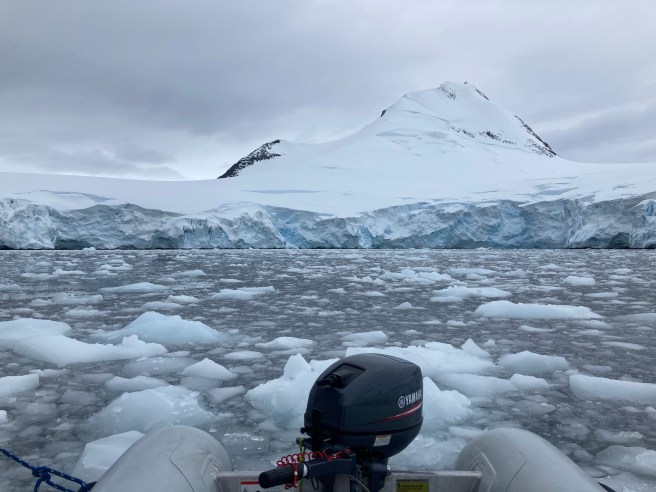
The forecast had been for 25-30 knot winds for which we had put in two (of five) reefs. Once clear of ice fields, where we saw numerous humpback whales, we got out to the open ocean and found the wind gusting closer to 50 accompanied by a steep chop. Barry went forward to put in another reef in the very difficult conditions.
Martha served up stuffed Red and Green peppers as our Christmas dinner (having served cooked roast lamb for Christmas Eve). She and Barry are experts on using a pressure cooker, vastly reducing the time and fuel needed to cook on the stove. After getting it under pressure, they often place the pressure cooker inside an upholstered case called a “WonderBag” to keep it warm (apparently the case was designed to help reduce the need for fuel when cooking, particularly beneficial in poorer countries).
A lively sail on Christmas Eve video
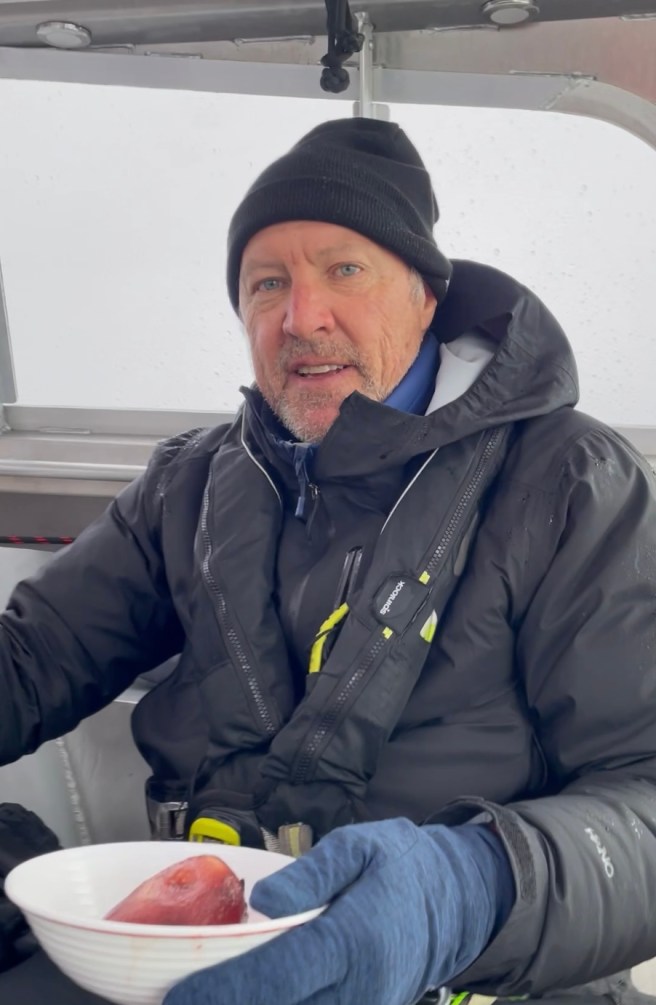
Sunday we had nice reaching conditions in 30-40 knot winds and made good time. We were acutely aware that the weather outlook called for extremely strong winds to dominate the Cape Horn region starting Wednesday afternoon. In fact Ken McKinley, our weather forecaster, had told us if we didn’t leave Saturday we might be stuck in Antarctica for another six days awaiting the next weather window to cross the Drake Passage. Speed was of the essence for us.
We had far fewer birds than on the trip south, but it was still fun to watch the majestic Albatross glide effortlessly no matter the strength of the wind. After we passed the Antarctic convergence zone the rise in temps made standing watch more comfortable. As we got further north we started to get a few hours of darkness at night. I was hoping to find the Southern Cross which had danced around our masthead when I was here in February 1985 but all I found on our cloudy evenings was the constellation Orion – upside down from what we’re used to in the Northern Hemisphere.
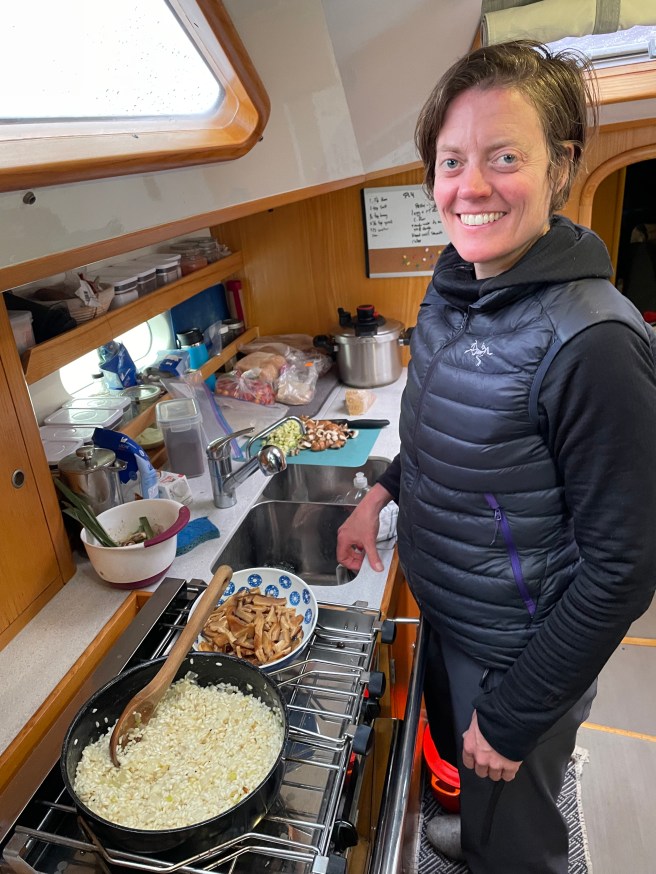
Once again we ate incredibly on the return trip. In the wee hours one chilly morning I was handed a smoking hot chocolate/banana cookie. Regular meals included chicken wings, pad Thai, short ribs, and a variety of homemade soups.
As we approached Cape Horn the wind backed to SW at 25-30 with regular squalls that reached well into the 50s. It’s hard to keep speed up in 25-30 knot winds when you have to keep sails reduced for sudden violent squalls, so it was an active effort trying different amounts of jib and staysail rolled out. We needed to sail as low as possible, without jibing, in order to clear Cape Horn – while fighting the tendency of the boat to round up in extreme squalls in the building seas.
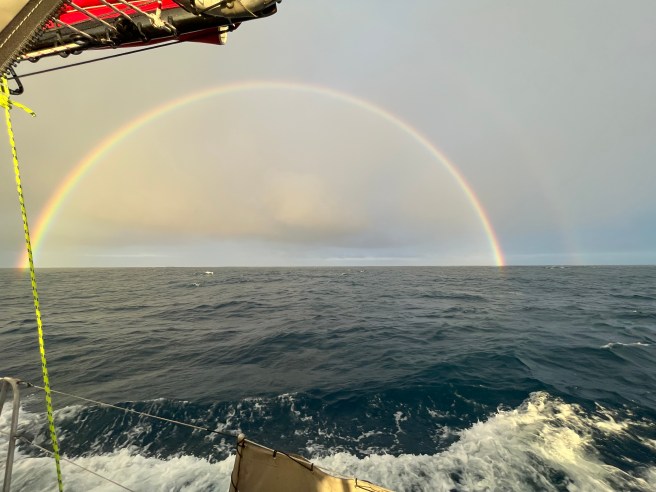
We saw Cape Horn’s lighthouse flashing as we sailed by in the darkness around 1 AM (yep, same time of night for me) then turned north onto a reach. It was still blowing 25-30 and gusting 45-55. We had 4 potential anchorages in mind, one of which we needed to get to before the forecast seriously heavy weather set in later in the day. We set our sights on Caleta Banner on Isla Picton, a small, very protected cove with good holding for our anchor.
The wind finally eased and we started the engine. Five miles from the anchorage our engine started to act up. We eventually diagnosed that it had a big piece of kelp wrapped around the propeller shaft. No amount of forward/reverse would disengage it so we considered sending a diver over, or else backtracking downwind to an anchorage we had passed earlier. After a half hour the kelp finally worked itself free and we crept into Caleta Banner just a few hours before the heavy winds began in earnest.
We anchored just past an old broken-down dock and read that Caleta Banner had once been a coaling station – and was where the vessel Yelcho had taken on coal prior to her voyage to Elephant Island to relieve Shackleton’s men in 1916.
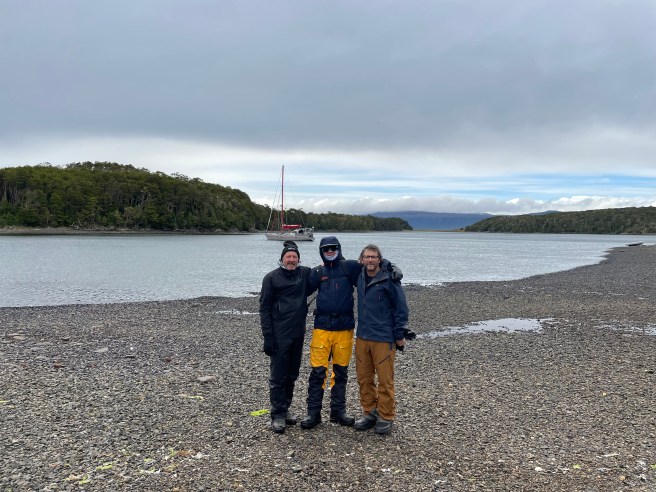
We hear of cruise ships returning to Ushuaia to prepare for the heavy winds. We plan to wait them out here for the next couple days, then head to Puerto Williams to clear in (and then out) of Chile, then head to Ushuaia. We will help Barry prep the boat for a second trip to Antarctica starting around January 8.
An old adage says “A man who would go to sea for pleasure would go to Hell for past time.” While that descriptor might apply to parts of our voyage, I prefer to think we go to sea to behold the natural world and the wonders of creation. Antarctica and the waters coming and going certainly fit the bill.
Part Five: The last leg
The Chilean Navy keeps tight control over their waters. We had to ask permission for the route we planned to sail and every harbor we wanted to stop at. Fortunately, the Chileans have a reputation for being reasonably understanding and recognize that yachts often have need of entry to sheltered harbors.
We were invited ashore by the Naval officer at Isla Picton. Todd, Dalton and I rowed in to his home and we were immediately welcomed with kisses by his wife and two daughters (ages 15 and 6) who are the only inhabitants on the island. They will be here for a year with the possibility of a second year added on. It’s considered a plum position to oversee one of the outposts, though it took the teenage daughter some adjusting – especially considering their internet got taken out in a recent gale! We had brought in two large grocery bags of oranges, melons, chocolate and the like which were warmly received, as their supply boat comes only once every two months. It reminded me of the lonely lifestyle of lighthouse keepers back in Maine in days past.

Our very protected sanctuary proved a little less ideal when we started dragging our anchor. There was kelp all over the bottom and once it starts wrapping around the body of an anchor it raises havoc when the wind shifts and the anchor no longer has a sharp point to stay dug into the mud. Further, every time we hauled the anchor up it was bulging with a mound of tough, stringy kelp that needed to be cut free before we could re-anchor. It took 3 tries but we finally succeeded.
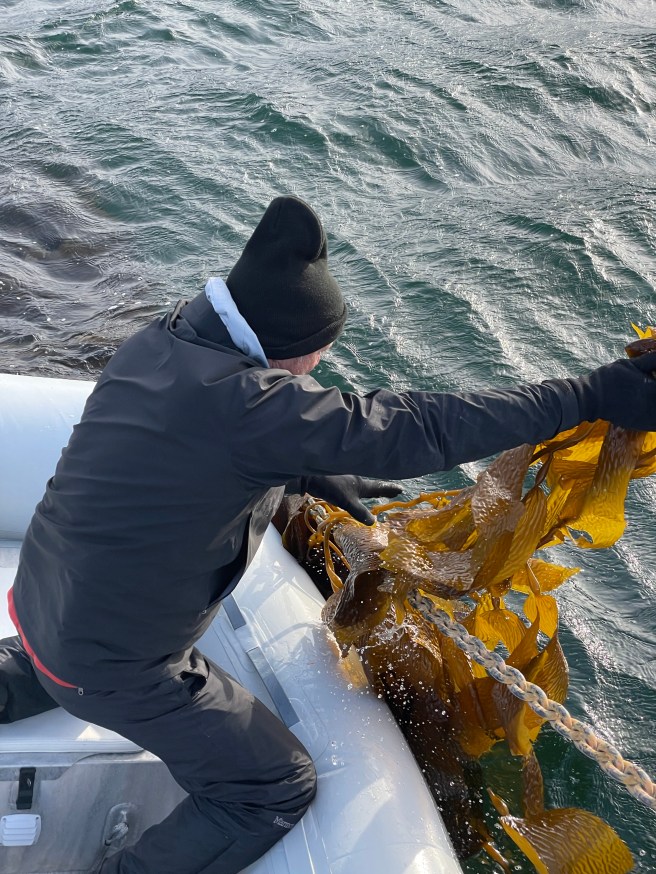
We finally got a break in the strong winds and motored to Puerto Williams to clear in – and out – of Chile. As background: If you want to sail through Chile when returning from Antarctica – which you normally do, in order to have more options for safe anchorages – you need to clear out of Argentina bound for Chile. Another wrinkle is that Argentina considers Antarctica their territory, and will not give an international exit clearance to Antarctica (why should they, when in their eyes it’s part of Argentina). It all adds to the complexity of sailing down here, where the weather can be challenging enough as it is! (And as I mentioned before, the two countries are very hostile to each other. Life would be much simpler for sailors were it all one country).

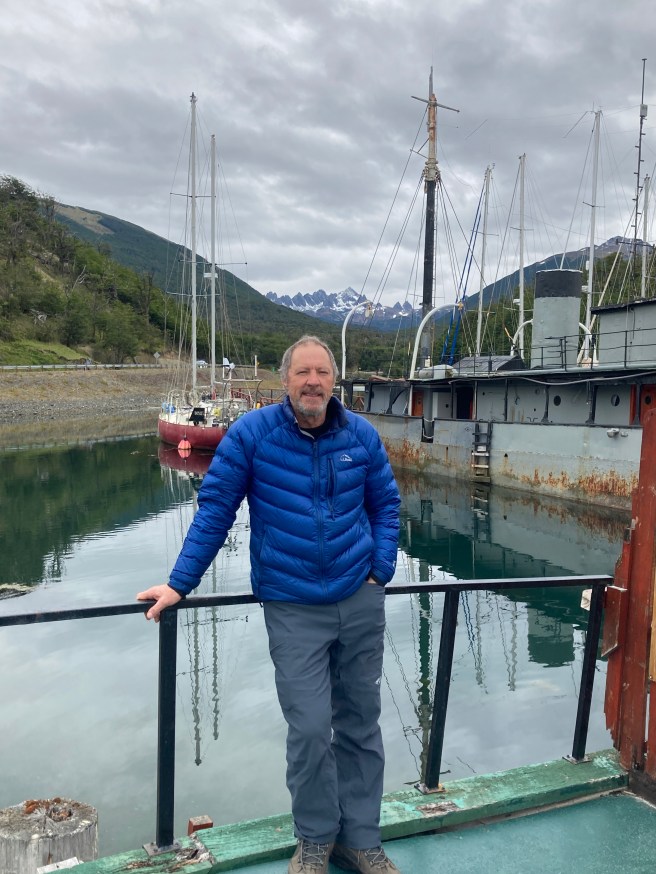
We tied up to the Micalvi, a grounded ship that has served as one of the southern-most bars in the world, famed for the many legendary sailors who have sheltered and wintered here over the years. The Naval officials in Puerto Williams initially told us we could not do our clearance for 3 days due to it being a national holiday for New Years. In a demonstration of their goodwill, and friendliness on the part of Barry and Todd, they bent the rules, and we were able to clear in and out in a few hours.
We scooted back to Ushuaia in time for a cookout at the Marina’s clubhouse to celebrate New Year’s Eve. At the party I met a group of 8 (7 women, 1 man) who had just flown to Ushuaia and were meeting each other for the first time. They are paying passengers aboard Spirit of Sydney, bound for Antarctica, being co-skippered by a young couple. None of the 8 had much sailing experience. I marvel at the fortitude of a young couple handling a 60-foot boat essentially by themselves across the Drake Passage, on top of cooking, entertaining and watching after 8 guests.
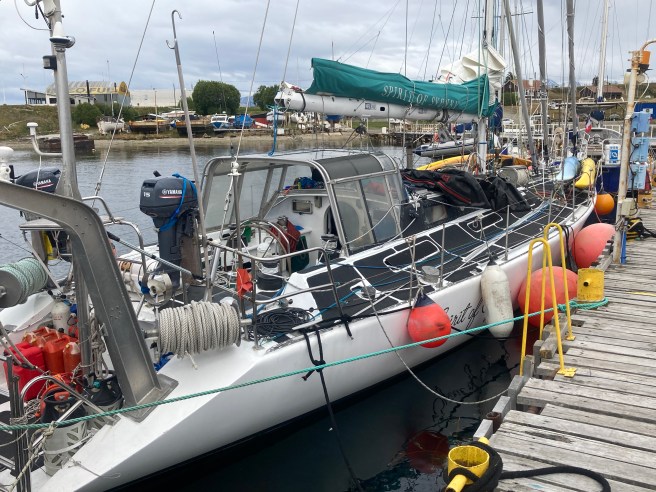
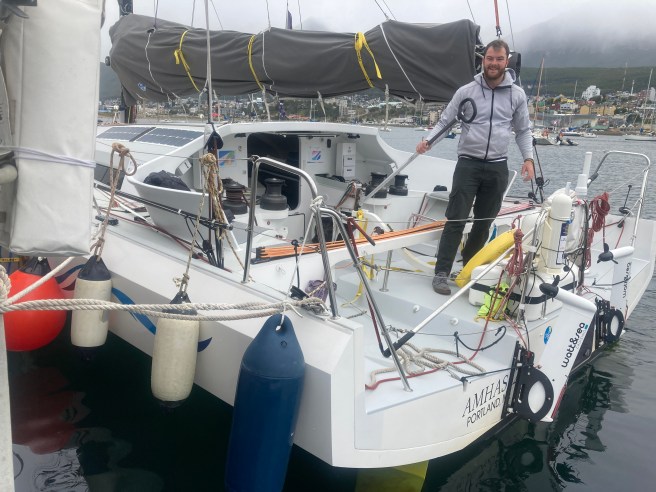
In a small-world moment, I returned to the boat one day to find a sleek racing yacht tied up alongside Gringo. The Globe 40 double-handed Round-the-World Race is taking place, and one of the stops is Ushuaia. The boat that tied up to Gringo is from Portland, Maine, and is being co-skippered by Brian Harris who manages Maine Yacht Center. Unfortunately I just missed Brian before he flew home, but I did meet the crew who will be doing the next leg of the race to Recife, Brazil.
Due to continuing extreme inflation, the “Blue dollar” conversion rate has gone from 300 pesos per US$ to 340 in the space of a month. At least the Argentinians have their recent World Cup victory to brighten spirits in an otherwise dizzying economic world.
An elephant seal playing in Ushuaia video

Thanks again to those of you who have followed along. The photos and videos used in this blog were taken primarily by Todd and me.
Max
 Sailing Stories - Max Fletcher
Wow Max what an incredible experience, I’m sure those memories will stay for ever . Great description, I felt as if I was on the trip too. Lucky you to have found a way to go to Antarctica . How will you too this … we will wait and see x
LikeLiked by 1 person
Wow guys, this was the trip of a lifetime! I loved every word of this post!
You should start a youtube channel as well, many sailors are doing it successfully.
It was nice meeting you in New Orleans!
LikeLiked by 1 person