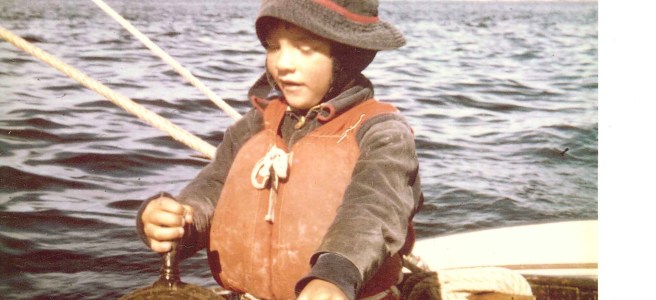
I feel fortunate to have grown up on the coast of Maine, in a political/economic era of relative stability and opportunity. I’ve been able to make sailing voyages to unusual places, and to parts of the world such as the Caribbean and the South Pacific before it became commonplace to do so. I find it interesting to learn how others have navigated life’s choices in order to stay true to their dreams and their values. I created this blog in part to share the choices I have made, and the resulting experiences I’ve had.
Childhood
From an early age I had the sense that I had only one life to live and that I should make the most of it. I loved nature and the natural world. I had a deep skepticism about the dogma our culture imposed upon us, preferring to make ‘an original relation to the universe.’ Other cultures, and other historic periods, must have a lot to offer besides what was billed as “the American dream” (which I came to interpret as a fifty-hour workweek, two weeks’ annual vacation, a golden handshake at age 65, and a heart attack at 68).
I benefited from several lucky breaks in my life. Foremost among these was having Abbot for a father. He had grown up in an old New England family with deep roots in America’s history. He spent his childhood in Newport, Rhode Island, home to a rich yachting tradition and the America’s Cup races. Abbot learned to sail intuitively, in classic wooden gaff-riggers, immersed in old-school navigation, seamanship, and maritime lore. He became an extremely talented sailor, eventually bringing his experiences from the age of traditional sail to modern yachting in Maine.
Learning to sail at an early age became the defining influence in my life. Sailing combined several elements that would become integral to my goals and values: personal freedom and self-reliance, travel and exploring other cultures, connection with the natural world, and seeking meaning beyond life’s daily routines.
Another lucky break was getting to spend summers in a rustic family cottage overlooking Beal’s Cove on Orr’s Island. My neighbors, brothers John and Peter Arndt, as well as their cousin Smoke who lived on a nearby cove, became my best friends and fellow adventurers. Summers were spent sailing Turnabouts and later a Thistle, unsupervised and frequently late into the night. We rowed small dinghies 7 miles to Halfway Rock, played kick the can on deserted islands, swam across Harpswell Sound, played tennis, went tuna fishing several miles out to sea in a Boston Whaler, and enjoyed a freedom increasingly rare in the modern world.
From around age 12 I started to develop the desire to sail beyond the far horizon. I have 33 pages of notes and diagrams I made of Roger Manry’s voyage across the Atlantic in a 13 1/2-foot open sailboat. It seemed entirely within my ability to do something similar, and the budget seemed within reach. I was spellbound reading of Robin Lee Graham’s solo circumnavigation in a 24-foot boat. At age 15 I told my dad I could break Graham’s record for youngest circumnavigation if only he would buy me a boat. Alas, he didn’t take me up on the offer, but I promised myself not to lose the desire to live life the way I envisioned it.
On weekends I raced with my Dad on our family boat Majek, more often than not on an overnight race somewhere along the coast of Maine. Due to my dad’s heavy workload at Bath Iron Works, starting at around 14 I became responsible for getting Majek to race sites up and down the coast, sometimes in thick fog, and often with just one of my sisters or my mother aboard. The 120-mile Monhegan Island Race was the pinnacle of the season, and for me an event bigger than Christmas. Majek had a successful racing career, competing in 34 Monhegans and winning her class more than a dozen times.
Schooling
Summers embodied unfettered joy, and the seeds of personal freedom took strong root. In contrast, the other 9 months of the year going to school in Bath were confining and not particularly happy ones. My parents allowed me the opportunity to go away for high school, and I came to love Phillips Exeter Academy despite a difficult transition to its rigorous standards. Sitting around an oval Harkness table with brilliant students from across the country and beyond, discussing ideas I’d never heard young people consider was intimidating, but it challenged me to grow. By my junior year I was thriving in the environment and had come to love subjects as diverse as creative writing and statistics. By the time I got to Yale I was somewhat burned out, but I found the first two years quite easy academically. I compensated for Exeter’s strictness by over-indulging in partying and catching up on the personal freedoms that had been denied at Exeter, where students were regularly kicked out for infractions as minor as drinking beer.
At a mixer one evening I noticed a sign on a wall: come join Yale’s sailing team. I had no idea Yale even had a sailing team, let alone one of the best programs in the country. I soon found myself sailing with some of the top sailors of the day – several of whom such as Peter Isler, Stan Honey, Steve Benjamin, and Dave Perry would go on to have illustrious careers at the top levels of world sailing. In 1976 I crewed with Peter and Stan when we won the collegiate national large-boat championship, and with Benj in a close 2nd at a Shields class nationals. I’m grateful for a sign on a wall that led me to sail with folks who continue to be leaders in the sport.
Caribbean Voyage
During our high school years John, Peter and I began to scheme to sail to the Caribbean. We read Don Street’s Cruising Guide to the Lesser Antilles, with its enticing descriptions of palm trees, crystal waters, friendly natives and steady trade winds. We looked for an inexpensive boat to buy – ignoring the meager sums in our bank accounts. We made plans to deck over their family’s Rhodes 19, sail down the East Coast and from there to the Caribbean.
Our determination became clear enough to our parents that the four of them held a pow-wow to decide whether they needed to stop us before our plans got to the point of no return. My father was clearly conflicted. He had recently told me that “taking a year off from college will cost you a year’s worth of income out of your life.” But during the parental meeting, with our sailing dreams hanging in the balance, Abbot offered that “if they need an extra anchor, they can borrow one of mine.”
Another lucky break now came along. John and Peter’s uncle Tom had purchased a Nicholson 35, a beautiful modern cruising boat. Soon thereafter he learned that his employer, the U.S. Agency for International Development, was sending him on a years-long assignment to Sri Lanka. What to do with his new boat? In an act of generosity for which I am forever grateful – and still in awe at the trust it placed in three teenagers – Tom offered to let us take Celestine to the Caribbean for the charter price of $2,000 for 9 months – what he estimated the depreciation on the boat would be.
We sent letters to our respective colleges taking a year off, and spent the summer of 1976 getting the boat ready while scrimping to save as much money as we could from our summer jobs. The only offshore experience any of us had was my having done the 1974 Bermuda Race and return voyage with a friend from Exeter. The insurance company was understandably reluctant to insure a near-new yacht to three teenagers, but my father went to bat for us and (as I later understood it) strong-armed his long-time insurance agent to cover the trip, which would include significant ocean passages.
We left Maine in the fall of 1976 with about $500 each, which carried us through the 9-month voyage. My uncle Rod had taught me celestial navigation while I was in 8th grade, and an acquaintance sold me his plastic Davis sextant for $15 with which I navigated the offshore passage from North Carolina to the Virgin Islands.
The trip throughout the Windward and Leeward Islands during the winter of 1976-77 – before the Caribbean became widely discovered – was magical and only whet my appetite to do more.
The South Pacific and Southern Ocean
After graduating from Yale I settled into my parents’ house in Bath and accepted a job in the planning department at Bath Iron Works shipbuilders. John and I continued to write endless streams of letters back and forth reaffirming our commitment to world cruising while trying to figure out how to finance it. We talked of creating a small business and taking turns running it, or working for and eventually buying a Caribbean charter boat company. In the meantime I toyed with the idea of building a James Wharram catamaran in which to cross oceans. Having read of Ernest Shackleton in the 5th grade, I now became enamored with the British mountaineer H.W. Tilman who sailed wooden British Pilot cutters to remote destinations in order to climb mountains. I purchased charts and sailing directions for Greenland and made extensive notes.
In 1979 a long-time friend of my family who summered on Orr’s Island asked me to race with him aboard his Pearson 33 in the Marblehead-to-Halifax Race. During the race Bud Edwards asked me what I planned to do with my life. “Sail around the world” was the reply. Bud owned a manufacturing business in Syracuse, NY and in the months following the race he approached me with a proposal: he’d always wanted to sail around the world but running a business made it impossible to do. He would like to partner with me, help finance it, and join me at regular intervals during the trip. We made a deal with Abbot that in return for upgrading Majek with a new engine, sails and other needed improvements, we would take Majek around the world for two and a half years, while Bud and Abbot shared Bud’s Pearson 33 in Maine. Bud had one caution for me: “don’t screw it up by getting married.”
But his daughter caught wind of the trip and thought she would like to sign on. One thing led to another and before we knew it, a baby was on its way. This had the potential to impact our plans, but we were put in touch with a couple who had circumnavigated in the 1970s, Scott and Kitty Kuhner, who are enthusiastic ambassadors of world cruising. They in turn connected us with a couple of families who had cruised with infants, both of whom encouraged us to continue with the trip.
Bud began urging me to look for a boat that might be more suitable for a family than Majek would be, and I found a very reasonably priced and seaworthy S&S 30 located in Essex, CT. Scott came and looked at it with us and commented that while the boat could no doubt make the voyage, a more suitable boat would be the rugged Westsail 32 with a For Sale sign tied up on the other side of the dock. Purchasing the Westsail instead of the S&S was another lucky break, as we shall see shortly.
We left Maine in the fall of 1982 when my son Chris was 9 months old. We traversed the Panama Canal in April 2003, and sailed 22 days from the Galapagos to the Marquesas Islands. Being on a voyage for 3+ weeks with nothing but the wide ocean and his parents, Chris started crying in fear when we first spotted the peaks of Fatu Hiva rising out of the sea. We spent the hurricane season in French Polynesia, then continued on to the Cooks, Samoa, Tonga, Fiji and arrived in New Zealand in the fall of 1984. It was utter joy to be with Chris 24/7 during those formative years.
Getting from New Zealand back to Maine involves crossing long stretches of ocean, including the Indian Ocean with its reputation for heavy seas and storms, and my wife was understandably reluctant to do so. I was considering my options when another lucky break came along. I had gotten to know Rob Andrews, 3 years younger than I and with similar dreams and sailing abilities. Rob was a paid skipper aboard a beautiful Swan 65 following a similar route as ours from Samoa to New Zealand. At the Duke of Marlborough pub in Russell, New Zealand we’d had too much beer and talked of our sailing goals. There was a map of the world on the wall above the table and we pointed out places we would like to sail some day. We agreed the ultimate would be to sail around Cape Horn. Rob looked at me and said, “the quickest way for you to get back to Maine would be by way of Cape Horn. If you want to do it, I’ll go with you.” Having purchased a stout Westsail capable of making a voyage across the roughest ocean in the world was one lucky break; having Rob drop into my life at that particular moment was another.
After working night and day for 3 1/2 weeks to make Christopher Robin as seaworthy as possible, we departed New Zealand January 9, 1985. Our 52-day, 5,600 mile voyage included a severe knockdown well past horizontal, a 60-hour gale during which we hand-steered with no sails up making 130 miles a day, and crossing over so-called Point Nemo, the point on earth farthest from land. We rounded Cape Horn on February 25, a date on which Rob and I never fail to connect by telephone to toast with a tot of rum.
Career
Back in Maine after a successful sail home I knew the fun was over and that in order to do more long sailing trips in the future, I needed to excel within the capitalist system. During a job interview at General Electric the interviewer concluded that “the best part of a career at GE is the golden parachute once you’ve worked here for 40 years.” I practically died inside.
During an informational interview, the venture capitalist I was meeting with mentioned that a person named Dodge Morgan had his boat tied up at the waterfront and was leaving the next day to sail around the world alone and nonstop, hoping to set records in the process. I happened to have a copy of my journal from the Southern Ocean with me, so I drove down and introduced myself to Dodge and gave him a copy of the journal. A couple of years later when I ran into him again, Dodge told me “I read your journal and told myself “If these two idiots can do it, so can I.”
On my way to job interviews I passed a small sign, “Brunswick Technologies”, a half-mile down the road from my home on Orr’s Island. I stopped in one day and learned that a Norwegian had recently founded the company, applying cloth-making technology to create knitted high-tech composite fabrics for the marine industry. He could only afford to pay me $5.50 an hour but said he needed someone bright around, and that I could grow with the company. I eventually taught myself accounting, wrote the first business plan, and became the CFO. Being at the center of production planning, purchasing, payroll, and banking relations was a priceless learning opportunity for me, and I learned that common sense went a long way to succeeding in the business world. The company was seriously under-capitalized, and I sometimes arrived at work on Monday morning unsure of how we were going to meet the payroll that week. But I was honest with our creditors as to our financial difficulties, and was amazed how supportive they were in return for the transparency. We eventually attracted venture capital (including an investment by Dodge Morgan and the VC investor who had sent me to see Dodge) which put the company on more solid financial footing.
I wasn’t looking to change jobs, but a neighbor and friend, who was sales manager for an industrial gas and welding supply company, encouraged the owner of the company to hire me. It was an opportunity for me to join a long-established company in a far less stressful situation. The owners had traditionally shunned taking loans from banks and as a result rented, rather than purchased, the steel cylinders that they in turn leased to customers. I convinced them that taking out bank loans and purchasing cylinders would enhance cash flow and grow the overall value of the company by a wide degree – many multiples of my own salary. The company’s financial trajectory changed dramatically as a result.
The company had a 401K plan, and I was able to put 21% of my salary into the plan with another 4% added by the company. I still have the page on which I estimated how that account would grow – my ticket to freedom. I seldom went out to dinner or bought new clothes, and drove the cheapest car I could find. My focus was on building financial options and freedom.
Northwest Passage Attempt
In 1984 I started corresponding with a highly experienced polar sailor, Newbold Smith, which soon evolved into a plan to attempt the Northwest Passage in his Farr 44 Reindeer. Abbot and Bud also signed on, and by the late 1980s planning was in high gear.
I was reasonably confident that I could take an unpaid leave of absence from my job. The woman who had managed the books for decades, and for whom I was gradually taking over, would have no problem covering in my absence. I wrote a letter to my boss explaining the very unusual opportunity I had, and that a successful transit of the Northwest Passage in a small yacht would mean some world “firsts.” He was not sympathetic and made clear I needed to choose between my job and the trip. Abbot, who had once reminded me that taking a year off from college would cost a year’s income out of my life, now told me that “you won’t get many opportunities in life to sail to the Arctic with Newbold Smith.”
In the end I negotiated a 4-week ‘extended vacation’ and made plans to join the boat near the entrance to the Northwest Passage. 1991 turned out to be a severe summer for ice, and Reindeer had a challenging trip up the Greenland coast. They eventually reached latitude 78 North, about 720 miles from the North Pole where they were stopped by a wall of solid ice stretching from Greenland to Ellesmere Island.
My mom drove me to Ottawa to board a plane for a long series of hops, the last of which would take me to Pond Inlet, at the northern tip of Baffin Island, where Reindeer was waiting. Ice conditions continued to be very severe and a choke point in the Northwest Passage was blocked by ice, so we had to abandon any hope of doing the Northwest Passage. Instead, we sailed nonstop from Pond Inlet down the east Baffin shore to Labrador and then on to Nova Scotia.
Marion-Bermuda Races
In 1992 I was invited to crew aboard a beautiful 44-foot yacht named Emily in the Newport to Bermuda Race. Sitting on the windward rail during the race it occurred to me that Majek would thrive in the reaching conditions typical of a sail to Bermuda. I started to think about entering her the following year in the Marion to Bermuda Race – a race designed for older boats with the proviso that navigation was to be done by celestial. My father quickly went along with the plan, particularly when I offered to pay the cost of getting Majek ready. We spent the winter doing necessary modifications to meet the safety requirements of the race.
The 1993 race turned out to be a fast reach the entire way. My brother-in-law Doug’s only sailing experience had been occasional sails and races aboard Majek but he offered to cook for the trip. In the Gulf Stream the winds were blowing hard and Majek bashed into the confused seas. Doug asked “Abbot, can the boat take this pounding?” Abbot’s reply might not have been the assurance he was looking for: “If she can’t, we shouldn’t be out here.” We finished the race with an elapsed time of 96 hours – a full day ahead of when we expected to finish. We were first in class and third overall. We did the 1995 race and placed third in class and again third overall.
Having a crew that had raced together for decades and knew how to keep Majek sailing consistently near her peak was one key to our success. Another was having situational awareness on the racecourse. To prepare for each race I tracked the movement of the Gulf Stream, and the eddies it spawned, for several weeks prior to the race in order to project where they would be during the race. I also pre-computed celestial navigation variables so that our morning and evening star sights could be taken quickly and efficiently.
For the 1997 race Win Fowler built us a Kevlar genoa which had as nice a shape as I’ve ever seen in a sail. Halfway through the race we, and most of the fleet, were steering to the west of the rhumb line in order to skirt around a large cold eddy and make the final approach to Bermuda from the west. In mid-afternoon I tuned our shortwave radio to pick up the latest high seas forecast, which suggested that a front was coming through and that favorable winds would last for a couple of days. Within minutes we decided to fall off the wind and head directly for Bermuda, picking up 3/4 of a knot boat-speed while shortening the distance we would have to sail. We kept our speed up all the way to the finish. On the strength of that strategic decision we won the race overall in a fleet of 84.
In 1999, we again won our class. Abbot was in excellent shape for anyone in their late 70s and showed no signs of physical distress during the race nor on the sail home. But in the Monhegan Race several weeks later he was in pain and frequently had his hand on his stomach. Soon thereafter he was diagnosed with an aggressive version of pancreatic cancer. He told his oncologist to give him whatever drugs were needed; he could handle the side effects. He didn’t want to die and the oncologist praised his toughness, but nothing was going to beat this cancer. I was able to spend nearly every evening with him during his last couple of months before he peacefully passed away at home, his three children and wife all holding his hands.
New Horizons
During the 1990s I kept my eyes out for a suitable cruising boat to buy, and drove to Mt. Desert to look at a particularly nice Bob Perry-designed Nordic 40. Abbot asked what I thought of the boat to which I replied “It’s the nicest 40-footer I’ve ever seen.” To my surprise he said he’d like to go look at it, and after doing so said that we ought to sell Majek and buy the Nordic. We were getting ready to put in an offer when dad went out on Majek and had a particularly glorious sail and decided that Majek was too nice a boat to sell. Soon thereafter the owners of the Nordic 40 decided that SHE was too nice a boat to sell.
The internet coming along when it did proved to be another critical lucky break for me. The norm for most individual investors at the time, including me, was to invest in mutual funds. With their sales loads, management fees, questionable incentives and tax disadvantages most mutual funds offered mediocre performance at best. The internet provided a platform to research stocks and invest in them directly rather than through mutual funds. I stumbled upon a small online group of professional microcap investors who generated plenty of ideas, and my financial background gave me a solid framework to analyze them. The late 1990s was an extraordinary time to be a microcap investor, and I made a number of highly successful trades.
On January 6, 2000, 4 weeks after my dad’s death, I took my mom out to lunch for her birthday. Completely out of the blue she asked “Whatever happened to that beautiful boat we looked at?” I told her I had heard it was recently put back on the market. She looked me square in the eyes and said “You go buy that boat.” Buying a boat had been the last thing on my mind during those sad months, but my mom was telling me to follow my dreams, as well as giving me permission to sell the boat that had been in our family 33 years and had meant so much to Abbot. My dad’s passing had a profound effect on me, upending inertia and complacency, and reminding me of the shortness of life.
Within a few weeks the owner of the Nordic 40 accepted my offer. A couple of years earlier I had purchased stock warrants in a small company with patents for making computer chips out of isotopically pure silicon, which had the potential to significantly improve chip performance. In a stroke of fortunate timing in the frothy days of early 2000, the warrants shot from 15 cents to $3 and $4 and higher. A few weeks later, on April 14, the Nasdaq fell 10% and by October it had lost 80% of its value. Though I took a financial beating along with most everyone else, I had paid off the boat from that one stock trade.
Central America and the Mediterranean
During the 1990s I was single with joint custody of my son. Chris was my #1 priority and I was protective of my time with him, particularly on weekends and vacations. As a result my dating life was sporadic, on top of which, when considering potential partners, my sailing dreams loomed large.
A new boat and my dad’s death were catalysts to plan another long voyage. Financially I was nowhere near being able to retire, but I had enough saved to go off for a few years and had marketable skills when it was time to return to the work force. After 13 years I felt I had done what I could for my employer and it was a good time to let someone else bring their expertise to bear.
My father had once worried that taking time off from work to go voyaging would cost me dearly in potential employer’s eyes. I have always found the opposite to be true: potential employers recognize that planning a voyage and setting off across oceans requires skills and qualities that are readily transferable to the workplace. In any event, I wouldn’t want to work for an employer who didn’t appreciate those qualities.
Another very lucky break came along when Lynnie Bruce and I started dating and soon discovered how much our interests aligned: travel, history, culture, geography, anthropology, family and sailing were all high on our list of mutual interests – plus she had a sense of adventure. She demonstrated an inordinate trust when in the space of a few months she married me, sold her house, quit her job and we hopped aboard Juanona, our Nordic 40, to head off sailing.
Our 3-year voyage took us down the US East Coast during which we encountered serious engine and transmission problems – a fortuitous time to deal with them before we got overseas. Friends we met in Florida encouraged us to stop in Cuba, which we hastily arranged to do before continuing on to Belize and Guatemala. Hitching around the western part of Cuba and getting rides in all manner of vehicles still ranks as one of the most “pure joy” experiences of our marriage. Chris sailed with us across the Atlantic, then we crossed the Mediterranean to Turkey before sailing home.
Retirement
Arriving home in 2004 I took a job with a small company in Brunswick developing advanced technologies for the Defense Department and, we hoped, for the marine industry. The owner and many of the employees were brilliant, and it was a fun atmosphere except for the aggravating complications of performing contract work for the US Government. I managed to get away to sail with a friend from Nova Scotia into Hudson Strait, an area almost never visited by modern sailing yachts.
By 2014 I was ready to retire. Lynnie has turned 60 and I was not far behind. We wanted to get back to voyaging before age became an issue. We set our sights on Norway, which we had heard was a remarkable area to cruise – an assessment that proved to be true in spades. We spent 2 winters in Ipswich, England, and 3 winters in Hoorn, Holland, making summer cruises to Scandinavia. In 2015 we spent 5 magical weeks north of the Arctic Circle getting as far as Norway’s Lofoten Islands, and made subsequent summer cruises to Denmark, Sweden, and to Finland’s Åland Islands. Winters in Europe were like being in a candy shop. We crisscrossed the continent by car and by air, and securing temporary Dutch residency allowed us to stay in the Eurozone indefinitely.
By 2019 it was time to start thinking of bringing Juanona home. We sailed from Holland to Brittany, then across the Bay of Biscay to Galicia, Spain where we left her alongside a dock in a small, friendly marina. We were home in Maine for a couple months, planning to return to Juanona in time for a May departure to cross the Atlantic. Then Covid hit. We were fortunate not to be stuck on the boat in a foreign port, but we also worried how she was faring. In April 2021 we finally got our Covid shots and flew back to Juanona. We had her hauled out of the water to clean the bottom, provisioned, re-fueled, and were ready to go within a week of our arrival in Spain. She had weathered our 18-month absence with minimal problems.
We had left a small potted jade plant under the dodger in the cockpit. It must have gotten enough mist from the frequent rains, while avoiding being blown right off the boat, because miraculously when we returned the jade was still clinging to life. It crossed the Atlantic with us and is now flourishing. Our 30-day nonstop voyage from Spain to Maine with our 26-year-old nephew Rudy was an absolute pleasure. I hadn’t made an ocean voyage in several years, particularly one long enough where your sense of time gets transformed and you are able to live entirely in the moment.
In December 2022 I had the opportunity to sail with an acquaintance to Antarctica, and in September 2023 Lynnie and I took a sailing trip (as paying passengers) on a spectacular circuit around Scoresby Sound on Greenland’s east coast.
I welcome questions and comments on the blog, whether publicly or by email. Thank you to those who have read these stories. I hope they have been of interest and worthy of your time.
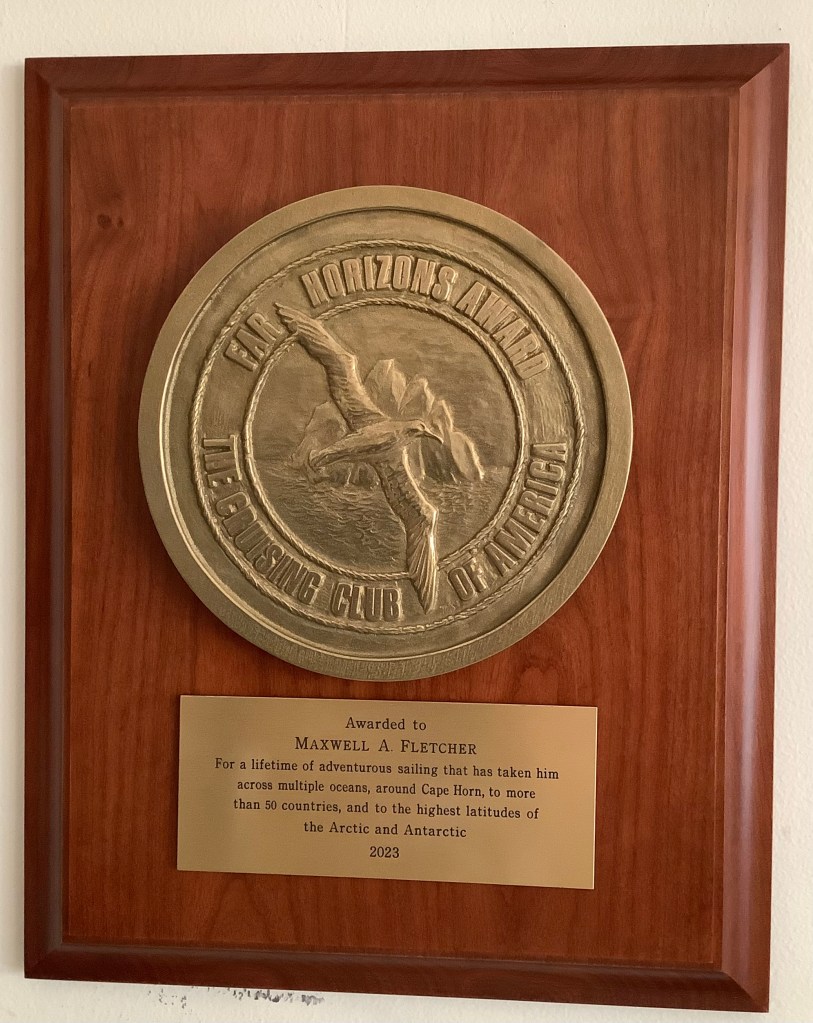
Postscript August 2024 I was both honored and humbled to have been awarded the Cruising Club of America’s “Far Horizons” award earlier this year. Several of my sailing heroes and mentors are previous recipients of the award. I’m proud of the CCA’s long and illustrious heritage, and grateful for the numerous ways that its members help to foster ‘adventurous use of the seas.’
 Sailing Stories - Max Fletcher
Wow, wow, wow. Gre
LikeLiked by 1 person
Living life to the fullest…. that’s all I can think of after reading of your experiences. Growing up on Orr’s Island has been the diamond in my tiara all these years and I can’t thank my father enough for all our experiences at sea fishing, lobstering, or just enjoying being on the ocean. You have created an amazing life !!
Regards, Susan
LikeLiked by 1 person
Max, this is just incredible. I guess I knew this was the life you dreamed of while we were at Exeter and Yale, including rooming together freshman year, but I didn’t realize you had actually done it! Bravo, my old friend. Eric
LikeLiked by 1 person